
- You do not have any products in your shopping cart yet.

Ultrasonic bird repellents – myth and truth
Can birds even hear ultrasonic sounds?
Not at all. The myth stems from confusion with mammals. Birds cannot hear ultrasonic sounds and even in the high-frequency range, they hear significantly less than humans. See below for details:Effective acoustic bird repellents for large areas:
How do ultrasonic bird repellents work if birds cannot hear ultrasound?
These bird repellents operate in the high-frequency range (1–20 kHz) and have a modest effect and high habituation effects. See below for details:How can birds be effectively kept away without disturbing humans?
Effective acoustic bird repellents naturally only work in the frequency range that birds can perceive, which humans inevitably hear as well. In order to combine effective bird repellents and noise protection, RAPTOR bird repellent devices work with:
- Key sounds that scare birds away but cause relatively little disturbance to humans
- Example: Birds of prey cries trigger flight reflexes in birds, but sound harmless and natural to humans
- Loudspeakers with directional sound
- Additional noise barriers if required

Before developing the RAPTOR bird repellent, we conducted extensive research and field trials with prototypes using a wide variety of phonoacoustic bird repellent methods. We would like to share our findings here:
Details on bird control with/without ultrasound:
1) Pure ultrasound bird control
A widespread misconception is that birds have the same acoustic perception as mammals. In reality, they have very different hearing; they only have one middle ear bone, the columella, a relatively short cochlea and no outer ear. This would also interfere with their flying. As a result, the perceptible frequency range of birds is somewhat lower than that of humans and much lower than that of many wild animals.Unfortunately, there is a persistent rumour that ultrasound (Wikipedia: definition of ultrasound) is the best method for keeping birds away without disturbing humans.
Our own practical experiments have shown that frequencies above approximately 4 kHz have absolutely no effect on birds.
This is consistent with scientific findings: birds cannot hear ultrasound!
Wikipedia: Hearing range of birds
Scientific papers on the subject of ultrasound: Frequency range of birds
What Can Birds Hear?
Robert C. Beason
Hearing Ranges of Laboratory Animals
Henry E Heffner* and Rickye S Heffner
HIGH FREQUENCY SOUND DEVICES LACK EFFICACY IN REPELLING BIRDS
William A. Erickson Rex E. Marsh Terrell P. Salmon
2) Frequency range: high frequencies approx. 2 kHz to lower ultrasonic frequencies >20kHz
There are ‘ultrasonic bird repellent devices’ on the market, but these actually only operate in the high-frequency range.From a technical point of view, this is very misleading:
the ultrasonic component that gives the device its name has no effect on birds, see (1)
the high-frequency range has a modest effect, however:
the acoustic range is low due to the very small loudspeakers and higher free-field attenuation at high frequencies
There are no pure natural scare sounds in this frequency range. It is therefore necessary to resort to artificial or heavily distorted sounds.
The habituation effect with such sounds would be very high.
Humans can perceive this frequency range better than birds, which is counterproductive in terms of noise protection.

3) Acoustic imitation of natural enemies in the 300Hz-5kHz frequency range (bird repellent principle: RAPTOR)
This method shows significantly better performance. Habituation effects are also minimal, as the animals are addressed on an instinctive level.The disadvantages of this method, high sound levels in the human hearing range, have been avoided through the following innovations:
- Use of natural sounds
- Use of loudspeakers with pronounced directionality
- Demand control via radio (RAPTOR remote)
- Combination of directional loudspeakers with sound barriers to prevent unwanted sound pollution
Frequency range: A perfect fit
The frequency range of the RAPTOR (300-5100 Hz) has been optimised to match the hearing range and maximal sensitivity of birds and wild animals. The RAPTOR does not use any frequencies that lie outside of the detection range of birds, which is something important in view of noise control. Though it can be loud if a person stands directly in path of the RAPTOR device (up to 125dB /1m), if the low noise recommendations are followed, the sound can often go unnoticed.
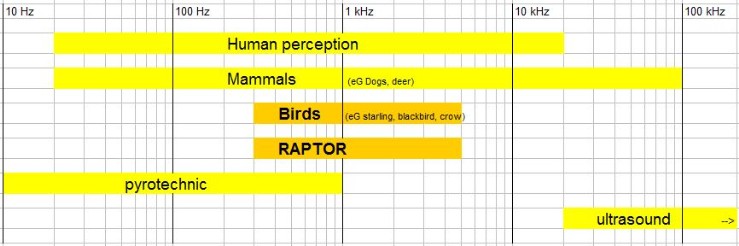
In comparison with other methods:
Pyrotechnics: ("firing devices") emit sound at a very high level in a lower frequency range. This range is irrelevant for bird control since birds cannot hear sounds below 300Hz. People, however, can in fact hear sounds in this range and, since lower frequencies can travel further, can still hear these sounds multiple kilometres away from the source.
Ultrasound:Though ultrasound can be heard by mammals, birds have a much differently constructed middle ear that prevents them from hearing these sounds. Mere ultrasound is therefore unsuitable for bird control. The “ultrasound bird control systems” on the market that emit sounds above approximately 2kHz can also be heard by people. Also, since the frequency range only partially overlaps with the hearing range of birds, and since the higher frequencies have a small acoustic range, these devices are only moderately effective.